
Maryland Financial Literacy Statistics
The Maryland Financial Educators Council (MDFEC) carries out research and gathers data to qualify financial wellness among residents of Maryland, then maintains and keeps those statistics current on this webpage. We provide these data for the use of legislators, the scientific community, nonprofits and other organizations, and individuals with a stake in promoting and advocating for financial literacy education. The statistics also support the implementation of financial literacy policy after it is legislated. By providing and curating these data, the MDFEC fulfills one important component of its financial wellness mission.
Cost of Financial Illiteracy Survey
Marylanders report that lack of financial knowledge carries a high cost, according to the NFEC’s most recent survey. Participants across the state responded to the single question: “During the past year, about how much money do you think you lost because you lacked knowledge about personal finances?” The results are shown below. Since 2017, the NFEC has conducted this annual survey, consistently revealing that the average individual cost of financial illiteracy approaches or exceeds $1,000 per person – with estimated national losses reaching into the hundreds of billions of dollars each year, and losses in the hundreds of millions across Maryland.
Cost of Financial Illiteracy
$0 – $499
$500 – $999
$1,000 – $2,499
$2,500 – $9,999
$10,000 +
Maryland Financial Vulnerability
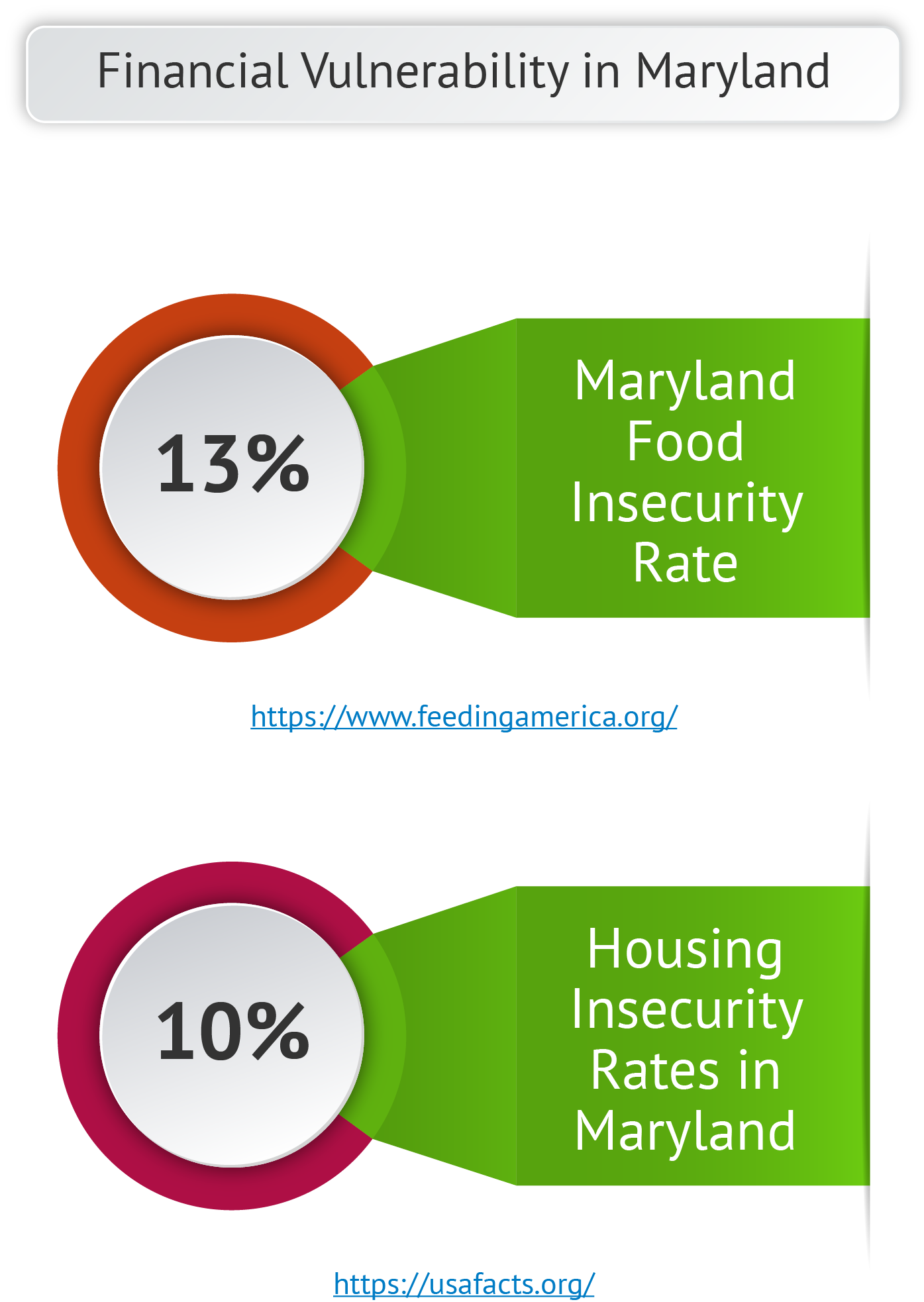
Financial vulnerability typically is gauged using two primary metrics: food insecurity and housing insecurity. Hunger affects 1 in every 8 Marylanders, according to Feeding America, a nonprofit organization that tracks food insecurity across the U.S. That proportion adds up to a significant problem considering the size of the state – representing 824,930 people or 13% of the total Maryland population. And among these food-insecure individuals, 219,040 (1 in 6) are children.
As regards housing insecurity, the World Population Review reports a total homeless population of 6,069 in Maryland as of 2024, for a homeless rate of 10%. Interestingly, that rate had decreased by 37% since 2007. The World Population Review defines “homeless” as living in a temporary shelter or transitional housing or sleeping in a place not meant for habitation (like an abandoned building). More than 500,000 Americans currently face homelessness.
Data Describing Marylanders’ Financial Situations
Average Total Consumer Debt
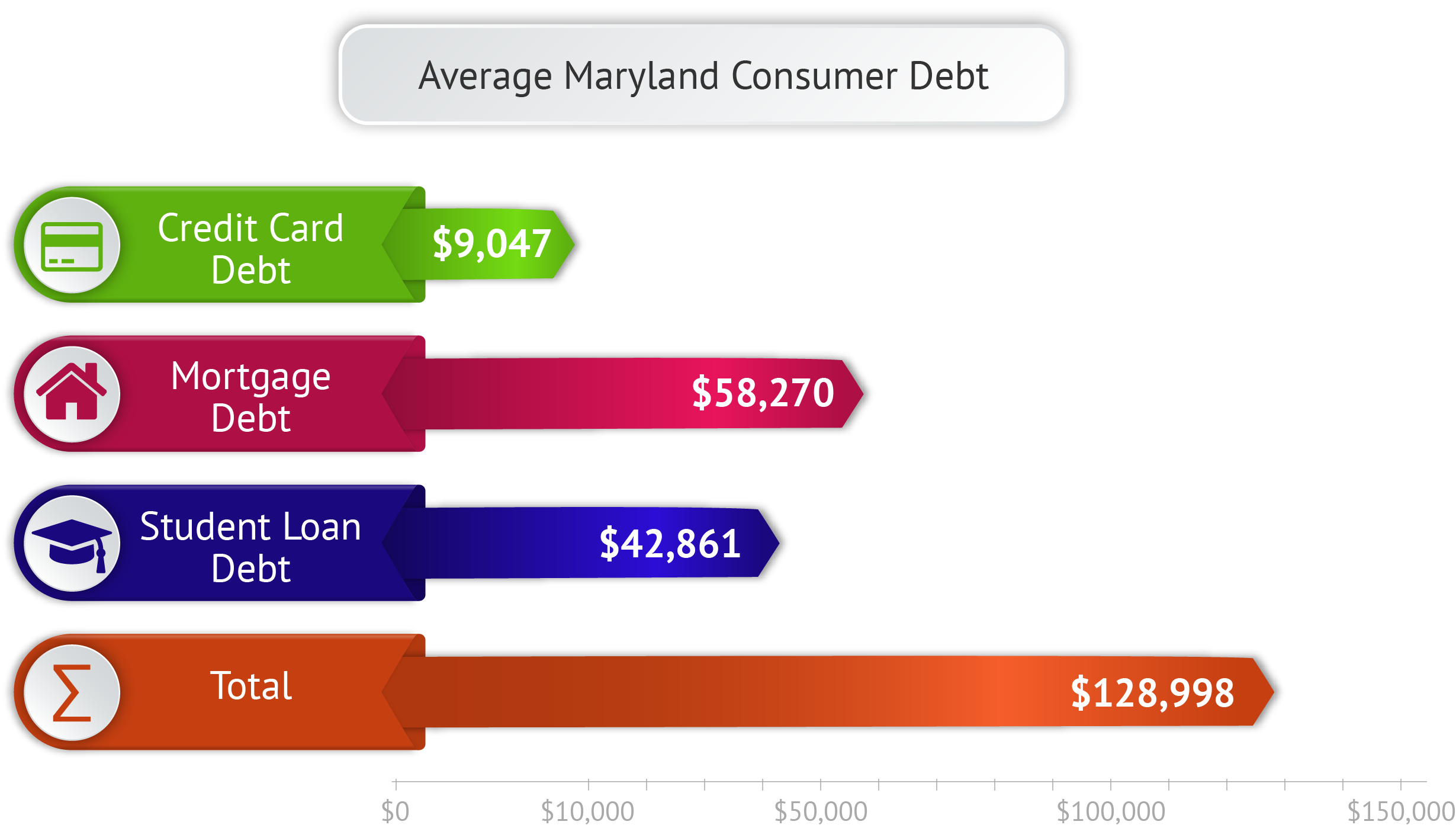
Total consumer debt in the U.S. has reached an all-time high, more than $18.3 trillion as of the end of 2025. In Maryland, the average total debt per consumer was $128,998 in 2025, according to a report from Experian. Although that figure indicates a 1.7% decrease in the state average from 2024, it is still well above the national average of $104,755.
Maryland Debt by Category
Looking at state debt burdens by specific categories, Marylanders who carry student loans had an average balance of $42,861 in 2026, as reported in another study from the World Population Review. That average extrapolates to $35.9 billion in total student loan debt in the state, ranking Maryland second in the nation after only the District of Columbia.
The Old Line State ranks third in the country for credit card debt, with an average balance per user of $9,047 as reported by WalletHub; the credit card delinquency rate in Maryland is 10.4%. Additional research conducted by the World Population Review showed that, in 2024, the average mortgage debt in the state was $58,270.
Maryland Financial Literacy Education and Legislation Statistics
The National Education Association (NEA) regularly issues a summary of public school information for U.S. states including total schools, teachers, and student enrollments by academic year. Its most recent report was published in 2025, and indicated that Maryland had 24 operating public school districts during the 2023-2024 school year. Those districts employed 63,220 teachers serving 890,137 student enrollees, for ratio of 14.1 students to each teacher.
Although until recently Maryland has not required completion of a standalone financial literacy course as a condition for high school graduation, that situation may change soon if House Bill 943 passes both state legislative bodies. HB 943 (Cross-filed with SB 592) was under consideration during the 2026 session of the Maryland General Assembly. The bill would mandate that the State Board of Education establish a high school graduation requirement aligned with the State Curriculum for Personal Financial Literacy Education Grades 3-12 Standards, which would go into effect with the graduating class of 2030.
Prior to the proposed legislation, Maryland policy relevant to financial literacy included Chapter 187 and 186 (House Bill 1242 and Senate Bill 533), which created a task force to “Study How to Improve Financial Literacy in the State.” The task force was charged to “study the current ability of high school students to understand basic financial concepts,” “evaluate the current provision of financial literacy education in Maryland’s public schools,” and “assess the utility of financial literacy education as part of primary and secondary education.” Following the task force’s recommendations, the State Superintendent of Schools created “a Financial Literacy Education Design Team to develop financial literacy education content standards – statements about what students should know and be able to do” as well as a “Financial Literacy Advisory Council to oversee the work of the design team and help leverage resources.”